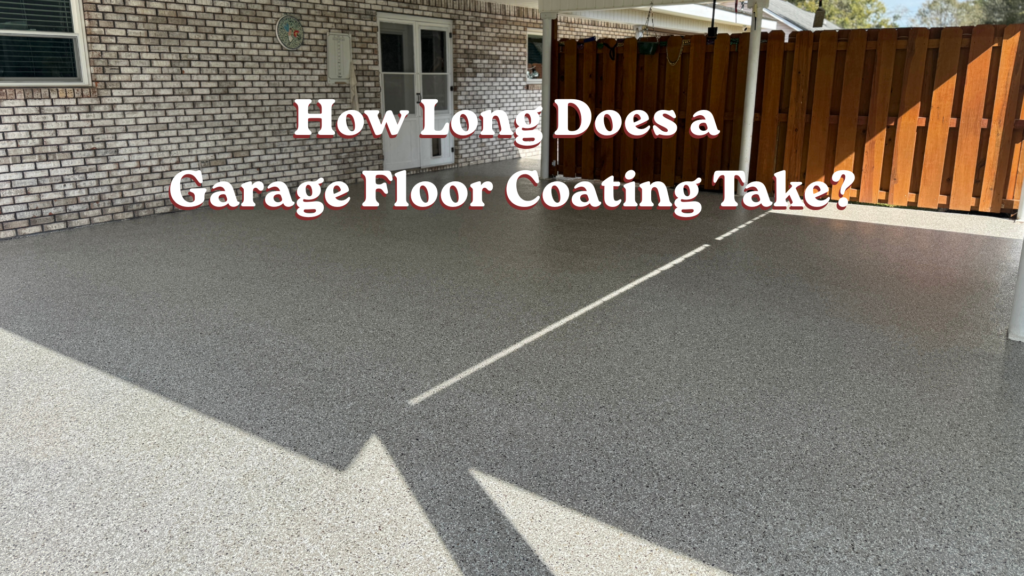
If you are thinking about getting your garage floor coated, the first thing you need to know is not the price. It is not the color options, it is not the warranty, and it is not the difference between epoxy and polyaspartic. The first thing you actually need to know is how long this is going to take, because you have to plan your life around it.
You need to clear out the garage. You need somewhere to park. You need to know when you can walk on it, when you can move things back in, and when you can actually pull your truck into the garage again without worrying about ruining a floor you just paid good money for. Those are the real questions, and they deserve real answers, not vague marketing language about “quick installation.”
So let’s break the entire timeline down from first contact to the day you drive your car back into a finished garage.
Here is the short version. If you are getting a polyaspartic coating system installed by an experienced crew, most standard residential garage floors are coated in a single day. You will be able to walk on it lightly within four to six hours. You can park your car on it within 24 hours. Full chemical cure takes about five to seven days.
If you are getting a traditional epoxy system, you are looking at two to five days of installation, sometimes longer, because each coat needs its own cure window before the next coat goes down. Full cure on an epoxy system runs seven to 14 days.
Those are dramatically different timelines, and the difference is not about one product being sloppy and the other being thorough. The difference is chemistry. Polyaspartic coatings cure through a chemical reaction that is fundamentally faster than the way epoxy cures. That is not a shortcut. That is how the product was designed to work.
When people ask how long does garage floor coating take, they are usually thinking about the day the crew shows up. But there is a timeline before that day too, and it matters because it is where the real quality decisions get made.
A legitimate contractor is going to want to see your concrete before quoting a price. This is not a formality. Concrete that looks fine on the surface can have moisture problems, hairline cracks, spalling, previous coatings, or oil contamination that changes the scope of the job. A contractor who quotes you a price from a photograph or a phone call is guessing, and that guess usually means corners will get cut once they are on site.
During the estimate visit, the contractor should be looking at the overall condition of the slab, checking for existing coatings or sealers, identifying cracks and joints that need repair, and talking with you about what the garage will be used for. A garage that houses two daily drivers and a weekend project car has different demands than a garage that is being converted into a gym or a workshop.
This is the step most contractors skip, and it is the step that causes most coating failures. Concrete is porous. Moisture from the ground underneath your slab migrates upward through the concrete as vapor. On the Gulf Coast, where humidity averages 75 to 85 percent year round and water tables are high, moisture vapor transmission is a real and persistent problem.
Professional moisture testing involves either a calcium chloride test per ASTM F1869 or a relative humidity probe test. The calcium chloride test measures the moisture vapor emission rate over a 72 hour period. Anything above three pounds per 1,000 square feet per 24 hours means the slab needs moisture mitigation before any coating goes down.
If a contractor does not test for moisture, they are gambling. And if that gamble does not pay off, the coating delaminates within months, and you are paying for the job twice.
Between the estimate, any moisture testing that needs to happen, and crew scheduling, the typical timeline from first contact to installation day is one to two weeks. Some contractors can move faster during slower seasons, some take longer during spring and summer when demand picks up. But that window is normal and reasonable. A contractor who can be there tomorrow might not have enough work to stay busy, which tells you something.
Here is what a typical one-day polyaspartic installation looks like on a standard two car garage, roughly 400 to 500 square feet.
The garage needs to be completely empty before the crew arrives. Everything out. Shelves cleared, cars elsewhere, nothing on the floor. The crew will set up their grinding equipment, check electrical access, and tape off anything that needs protection. This takes roughly 30 minutes.
This is the most important step of the entire process, and it is the step that separates a coating that lasts from a coating that peels. The crew uses a diamond grinder or shot blaster to mechanically profile the concrete surface to a CSP 2 to 3 per ICRI standards. That means the concrete surface has an open, consistent texture that the coating can physically bond to at a microscopic level.
Diamond grinding on a standard two car garage takes about one to two hours. Larger garages or garages with existing coatings that need to be removed take longer.
Why does this matter? Because the alternative that cheaper contractors and every DIY kit use is acid etching. Acid etching relies on a chemical reaction with the free lime in your concrete. It creates an inconsistent profile, it does not work at all on sealed or previously coated surfaces, and it leaves chemical residue that can interfere with coating adhesion. Acid etching is faster and cheaper, and that is exactly why it is the industry’s number one source of coating failure.
After grinding, every crack, divot, and damaged joint gets repaired. Cracks are filled with a flexible polyurea joint filler that moves with the concrete instead of cracking again. Expansion joints are treated according to their function. This step takes 30 minutes to an hour depending on the condition of your slab.
If your concrete has significant cracking or spalling, this step takes longer, and that is a good thing. A contractor who rolls right over cracks without repairing them is handing you a cosmetic floor with a structural problem underneath.
A penetrating primer goes down onto the freshly ground concrete. The primer seals the concrete pores, blocks moisture vapor transmission from below, and creates a chemical bond layer between the raw concrete and the base coat. This is the foundation of the entire system.
The base coat goes down, and while it is still wet, decorative flake is broadcast into it. The flake is not just cosmetic. A full flake broadcast adds texture, increases the system’s total thickness, and creates a surface that the clear top coat mechanically locks into. The base coat and flake broadcast together take roughly 30 to 45 minutes for a standard garage.
After the flake has bonded into the base coat, a polyaspartic clear top coat is applied over the entire surface. This is the layer that takes all the abuse, the tire traffic, the chemical spills, the foot traffic. The clear coat seals everything in and provides the final finish, whether you want satin, semi gloss, or high gloss.
By the end of the working day, the floor is fully coated. The crew cleans up, removes tape and protection, and walks you through the cure timeline. From the moment the crew arrived to the moment they leave, a standard two car garage typically takes six to eight hours of total work time.
This is where people get confused, because “done in one day” does not mean “fully cured in one day.” The coating is applied in one day. The chemistry continues working after the crew leaves.
Light foot traffic is safe within four to six hours. You can walk on it carefully without damaging the finish. Do not drag anything across it, and do not drop tools on it.
Vehicle traffic is safe within 24 hours. You can drive your car into the garage and park on it the next day.
Full chemical cure takes five to seven days. During this window, the coating is continuing to harden and reach its maximum chemical resistance. You should avoid harsh chemical spills, dragging heavy equipment across it, or placing jack stands on it during this period.
These milestones are consistent across most polyaspartic systems. If your contractor tells you something dramatically different, either faster or slower, ask why and ask what product they are using.
Epoxy installations work on a completely different timeline, and it is important to understand why so you can evaluate what a contractor is telling you.
Traditional epoxy requires 24 to 72 hours of cure time between coats. A typical epoxy system involves a primer coat, one or two base coats, and a top coat. Each of those layers needs to cure before the next one goes down. That means the project stretches across two to five days of actual installation work, with waiting time in between.
After the final coat is applied, full cure on an epoxy system takes seven to 14 days. Some manufacturers recommend keeping vehicles off the floor for a full week, and avoiding chemical exposure for two weeks or more.
Here is the math on a real scenario. Day one, the crew grinds the floor and applies primer. Day two, the primer has cured enough for the base coat. Day three, the base coat has cured enough for flake and the second coat or top coat. Depending on conditions, you might be looking at day four or day five before the final coat goes down. Then another seven to 14 days before full cure.
That is not because epoxy contractors are slow. It is because epoxy chemistry requires that cure window. A contractor who applies an epoxy system in a single day is either using a very thin system, a hybrid product that is not true epoxy, or they are not respecting the chemistry of their own product. Any of those scenarios should concern you.
The Gulf Coast is not the same as a dry climate with moderate temperatures, and anyone coating concrete here needs to know that.
Humidity is the biggest factor. Gulf Coast humidity averages 75 to 85 percent year round, and it gets higher during summer months. High humidity can extend cure times on both polyaspartic and epoxy systems. A polyaspartic floor that reaches light foot traffic readiness in four hours in Arizona might take closer to six hours here. An experienced Gulf Coast crew knows how to manage this by adjusting application timing and thickness.
Temperature matters too. Polyaspartic coatings have a wide application temperature range, which is one of their advantages, but cold snaps in winter can extend cure times. When temperatures drop below 55 degrees Fahrenheit, light foot traffic readiness can extend by two hours or more. Experienced contractors check the forecast and schedule accordingly.
Slab moisture is the hidden variable. In low lying coastal areas with high water tables, your concrete slab may have moisture vapor emission rates that exceed the adhesion threshold for most coatings. A contractor who does not test for this is setting up a failure, especially in a climate like ours.
The takeaway is not that Gulf Coast installations are harder. The takeaway is that experience in this specific climate matters. A crew that has done hundreds of installations in Biloxi, Gulfport, and Ocean Springs knows what 85 percent humidity does to polyaspartic cure times. A crew from out of town running the same playbook they use in Phoenix does not.
If a contractor tells you they can coat your garage floor in one day using a polyaspartic system, that is a legitimate claim. Polyaspartic chemistry was specifically designed for rapid cure, and one day installations are standard across the industry for residential garages.
What “one day” does not mean is that corners were cut. It does not mean the prep was skipped or the system is thin. A proper one-day polyaspartic installation includes full diamond grinding to CSP 2 to 3, crack repair, primer, base coat with flake broadcast, and clear top coat. All of those steps happen in one day because the chemistry allows it, not because the contractor rushed through it.
However, there are red flags to watch for. If someone claims they can install a true epoxy system in one day, that is a problem. Epoxy does not cure fast enough for that to be done correctly. If someone claims a polyaspartic system needs three or four days of installation time, that is also unusual and you should ask why. Either the scope is larger than a standard garage, the concrete needs extensive repair work, or they are padding the timeline.
Here is the complete picture of how long does garage floor coating take, from your very first conversation with a contractor to the day your garage is fully back in service.
Week one: Initial contact, estimate visit, concrete assessment, and moisture testing if needed. The calcium chloride moisture test requires 72 hours, so if testing is needed, this adds time. The contractor provides a written estimate with a clear scope of work.
Week one to two: You approve the estimate, the contractor schedules the installation. You plan to have the garage completely emptied by installation morning.
Installation day: Crew arrives in the morning, grinds, repairs, primes, coats, and is finished by end of day for a polyaspartic system. For an epoxy system, installation spans two to five days.
24 hours after installation: You can park your vehicles on a polyaspartic floor.
Five to seven days after installation: Full chemical cure is complete on a polyaspartic system. You can resume all normal garage activity, including heavy equipment, chemical exposure, and anything else the floor was designed to handle.
From the day you pick up the phone to the day you are parked in your garage on a fully cured floor, you are looking at roughly two to three weeks for a polyaspartic system. For an epoxy system, add another one to two weeks because of the longer installation and cure windows.
Now that you know what a legitimate timeline looks like, here is what should make you pause.
A contractor who quotes an epoxy installation in one day is not saving you time. They are either using a product that is not true epoxy, applying it too thin, or not waiting for proper cure between coats. Any of those means the floor will not perform the way it should.
A contractor who claims a polyaspartic installation needs three to five days for a standard residential garage is overstating the project, unless there are genuinely unusual circumstances like severe concrete damage, required moisture mitigation, or an exceptionally large space.
A contractor who will not tell you the specific cure milestones is hiding something. Every legitimate coating product has documented cure times from the manufacturer. If your contractor cannot tell you when you can walk on it, when you can drive on it, and when it is fully cured, they may not know what product they are using, which is a bigger problem than the timeline.
A contractor who says you can park your car on a freshly coated floor the same day it was applied is telling you something that contradicts the chemistry of every major polyaspartic and epoxy product on the market. Walk away.
Here is the practical advice for getting through installation day with minimal disruption to your life.
Clear the garage the night before. Do not plan to do it the morning of, because the crew is arriving early and they need an empty floor. If you have heavy items, get help moving them the day before.
Arrange parking elsewhere for 24 hours. Whether that is the driveway, the street, or a neighbor’s spot, your vehicles cannot be in the garage until the next day at the earliest.
Plan for noise. Diamond grinding is loud. If you work from home or have small children who nap, plan for a few hours of industrial noise in the morning.
Keep pets away. The garage will have wet coatings and chemical fumes throughout the day. Pets should be in another part of the house with the connecting door closed.
The day after installation, you can park your vehicles and begin moving items back in carefully. Avoid dragging heavy items across the surface for the first week. Lift and place.
By the end of the first week, your garage is fully back to normal, with a floor that will look and perform the way it should for years.
If you want to know exactly what the timeline and cost would look like for your specific garage, you can get a ballpark estimate in about 30 seconds at coastprocoatings.com/instant-quote. No phone call, no pressure, just a starting number so you can plan.
A three car garage is typically 600 to 750 square feet, and it adds time to the surface preparation step because there is more concrete to grind. A polyaspartic installation on a three car garage usually takes a full working day, sometimes running into the late afternoon. The surface prep alone can take two to three hours instead of the one to two hours needed for a standard two car garage. Cure times remain the same because the chemistry does not change with square footage.
With a polyaspartic system, light foot traffic is generally safe within four to six hours after the final coat is applied. This means you can walk carefully on the floor later that evening. You should not drag anything across the surface, drop heavy objects on it, or allow pets on it during this early window. The floor is cured enough to support your weight but has not reached its full hardness yet. With an epoxy system, you are typically looking at 24 hours or more before any foot traffic is safe.
For a polyaspartic coating system, 24 hours after the final coat is the standard recommendation for vehicle traffic. Your tires can sit on it, you can drive in and out normally, and the floor will handle it. For an epoxy system, most manufacturers recommend waiting at least 48 to 72 hours for vehicle traffic, and some recommend a full week. The difference comes down to how the two chemistries cure. Polyaspartic reaches functional hardness faster because the chemical reaction is more aggressive by design.
Rain does not affect the installation itself because the work happens inside your garage. However, if the garage is not fully enclosed, meaning the garage door is open during application for ventilation, wind driven rain could be a problem. Experienced crews monitor the weather and adjust ventilation accordingly. The more relevant weather concern on the Gulf Coast is humidity, not rain. High humidity can extend cure times slightly, and an experienced local crew accounts for this when scheduling and applying the coating.
Yes. Polyaspartic coatings can be applied in a wider temperature range than epoxy, which is one of their advantages for Gulf Coast winters where temperatures occasionally dip. But when the temperature drops below 55 degrees Fahrenheit, the chemical reaction slows down, and the cure time for light foot traffic can extend by two hours or more. Experienced contractors schedule around the forecast and may adjust application windows to the warmest part of the day during winter months. The installation still happens in one day, but the cure milestones shift.
Epoxy cures through a slower chemical reaction called an amine cure. Each coat needs 24 to 72 hours before it is hard enough to accept the next coat on top of it. This is not a deficiency, it is just the way the chemistry works. Polyaspartic coatings use an aliphatic isocyanate reaction that reaches functional hardness much faster, typically within one to two hours per coat. That is why a polyaspartic system can be fully applied in one day while an epoxy system needs two to five days. The trade off is that polyaspartic materials are more expensive per gallon, and the faster cure time means the installation crew has to work efficiently because they have a shorter open time before the product begins to set.